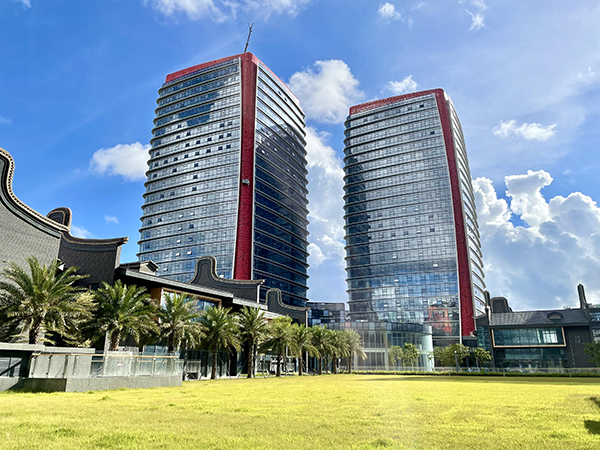
Guangdong Institute of Intelligence Science and Technology (GDIIST) is a research institution dedicated to brain-inspired intelligence research conducted in an organized, systematic, and full-chain manner. It is a non-profit public institution with independent legal person status, inaugurated in Hengqin on June 26, 2021. GDIIST operates under a president-responsibility system led by a Council, which is composed of the Executive Committee of Guangdong-Macao In-Depth Cooperation Zone in Hengqin, Zhuhai Municipal People's Government, and other parties. Its Academic Committee is comprised of academicians and renowned scientists in relevant research fields, while its Evaluation Committee consists of experts in academia, industry, management, and other domains.
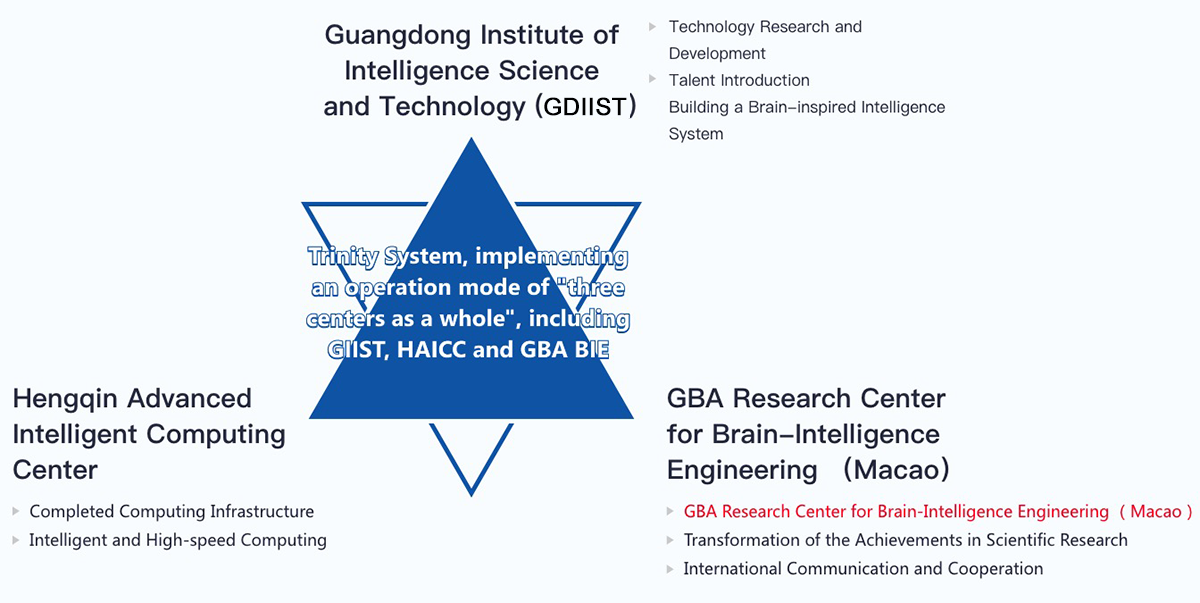
Targeting the development of the Western Point of the Guangdong-Hong Kong-Macao Greater Bay Area International Science and Technology Innovation Center, GDIIST supports Macao's high-tech R&D and industrial development, builds high-level science and technology innovation carriers and platforms, and advances the construction of major scientific and technological infrastructure, interdisciplinary research platforms, and frontier disciplines. Centering on five major directions—brain perception and cognition neural networks, brain-computer interface and modulation, brain-inspired algorithm models, intelligent chips and devices, and general brain-inspired computing systems—GDIIST has established three research centers (Cognitive Neural Networks Research Center, Brain-inspired Computing Systems Research Center, and Biomedical Intelligence Research Center) and two technology platforms (Neural Network Structure and Function Technology Platform and National New Generation Brain-inspired Artificial Intelligence Public Computing Open Innovation Platform). It has also established the GBA Research Center for Brain-Intelligence Engineering in Macao, creating an international research and innovation network, as well as a platform for academic and talent exchange and technology transfer and commercialization. Together with the University of Macau, it founded the "Joint Laboratory (Research Center) for Cognition and Brain-Inspired Intelligence" to jointly explore a new mechanism for close cooperation and a new model of science-education integration oriented toward major tasks and objectives.
Over the more than five years since its establishment, GDIIST has adhered to aligning talent team development with its development goals. In accordance with internationally first-class talent team development standards, it has made multi-pronged efforts in attracting, cultivating, retaining, and utilizing talent, striving to build a high-level talent team capable of tackling key challenges and excelling in innovation. It adopts a socialized employment system and market-based remuneration system, and explores flexible and diverse employment methods and categorized position management models, including full-staff employment, special appointments, and case-by-case arrangements for top-tier talents, establishing internationally competitive remuneration standards for the introduction of high-level talents. At the same time, in response to the development needs of its talent team, it has established an evaluation standard system centered on integrity, capability, and performance, organically integrating the position employment of researchers with professional title evaluation, term assessment, and annual performance appraisal. At present, it has gathered 370 research and administrative personnel, introduced 34 research teams, and undertaken or participated in 80 vertical research projects, including 46 projects funded by the National Natural Science Foundation of China and 11 Guangdong provincial science and technology projects. It has published 345 research papers in mainstream international academic journals. Papers in brain science have been published in renowned academic journals such as Cell, Cell Res, PNAS, and TINs, while papers in computer science and brain-inspired computing have been published in flagship journals in the field, including IEEE TCAS-I & II and IEEE TNNLS. It has applied for 83 invention patents and 40 software copyrights. It has produced internationally leading landmark achievements in brain-inspired intelligence, including the world's first brain-inspired heterogeneous fusion supercomputing system with a scale of 10 billion neurons, the first brain-inspired intelligent computing entity BIE-1, and the first "dream brain-computer interface" device.